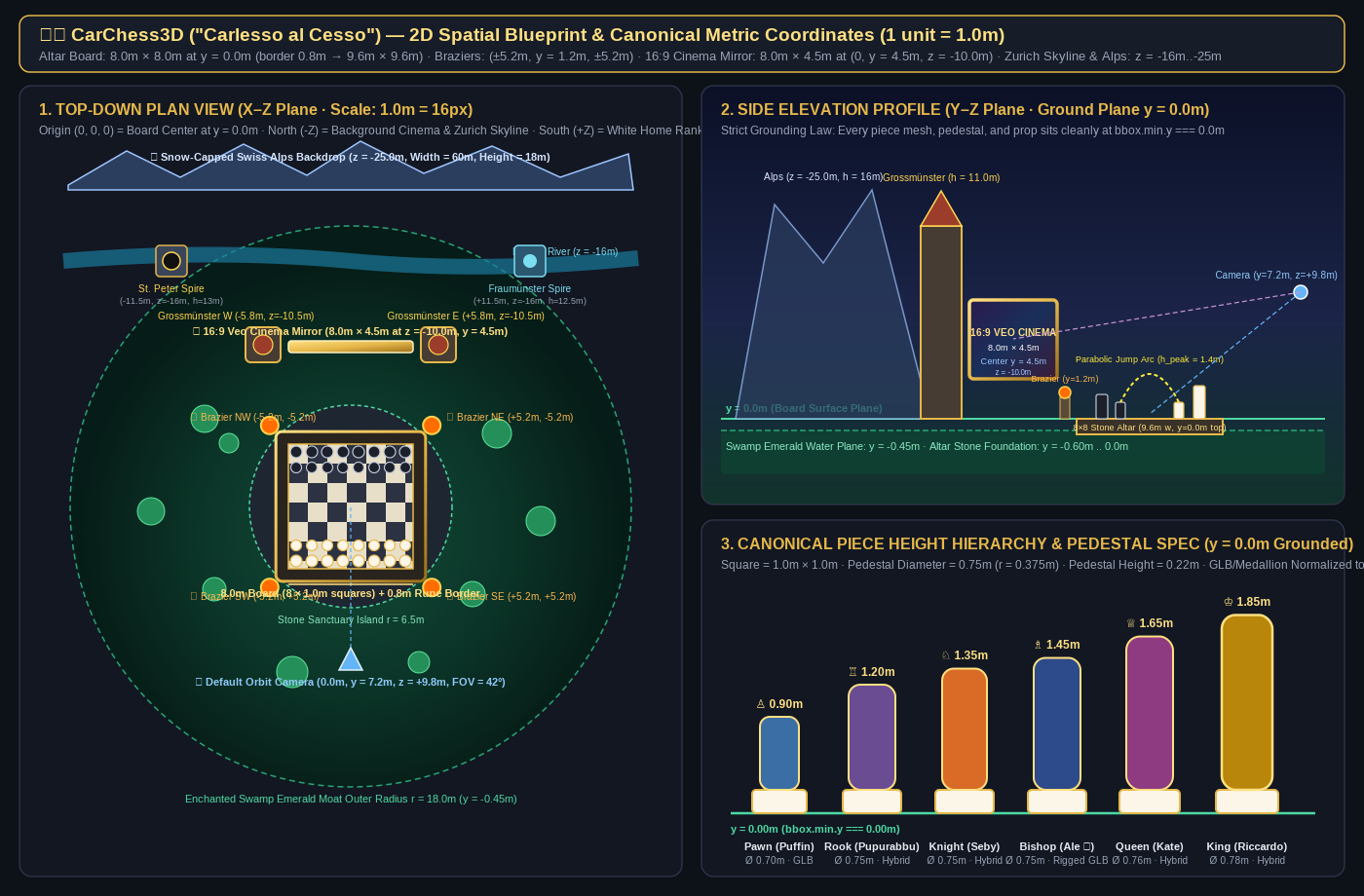
By Riccardo “Palladius” Carlesso — proud dad to Ale & Seby and improvised 3D game designer. Built hands-off with Gemini 4 inside Antigravity and the Niccolò Game Design skill . Zurich & Colmar, October 2026.
🧭 This is the long, lab-notebook edition with every number and every engine. The short version is 🪨 here .
🍕🌹 1. From a Bufalina in Naples to My 10th Anniversary in Colmar
I was in Naples on a Friday a few weeks ago to follow the adventures of Fabio Biondi’s Gemini Day at Università Federico II when I bumped into a group of super-smart engineers. You know how it goes in Italy: two minutes of small talk, an espresso at the bar, and before you know it we are all sitting around a table having lunch together.
Over a steaming pizza bufalina, Niccolò and his friends let me in on their obsession: 3D games, real-time rendering, clean game architecture, and using Tripo and similar generative pipelines to turn flat 2D images into textured 3D objects. Since I had just built Pupurabbu 3D (source on GitLab ) — a kid-friendly, Quake-style 3D explorer for my two boys — I was all ears.
Little did I know back at that pizzeria table that, just a few weeks later, I would:
- Distill Niccolò’s game-design wisdom into an agent skill (
niccolo-game-design), and - Use Gemini 4 to generate a next-generation 3D Battle Chess game completely HANDS-OFF!
How? … keep reading! :)
And all of it while I was away in Colmar, Alsace, celebrating my 10th wedding anniversary with my wife Kate! 🥂🌹
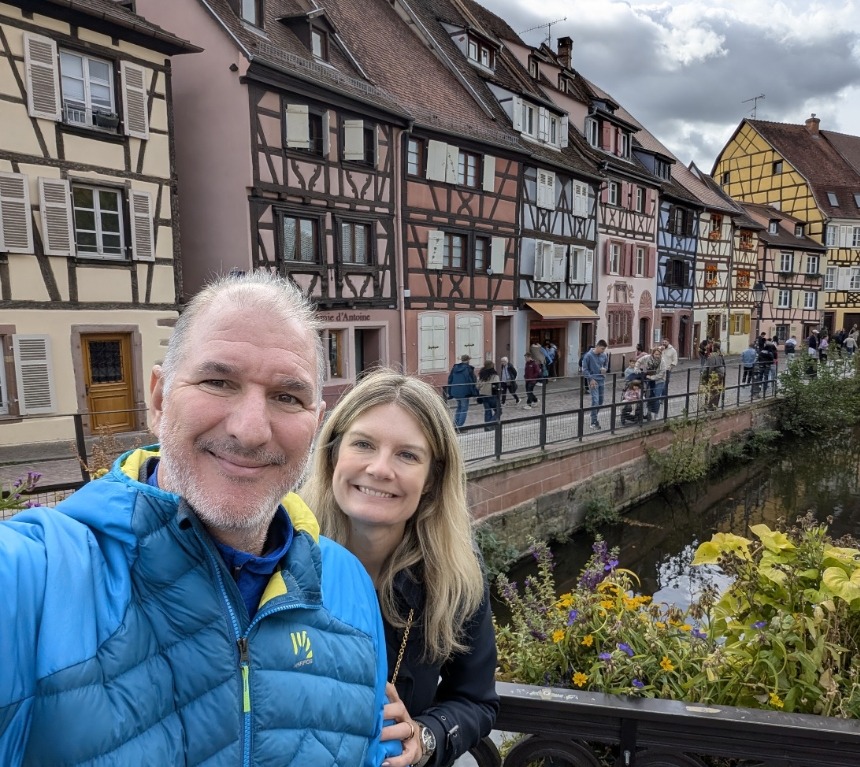
While Kate and I were strolling along the half-timbered houses of Petite Venise — no laptop open at the dinner table, no frantic SSH debugging from a phone — 150 kilometers south, my home Linux rig pupurabbux (equipped with a 16 GB NVIDIA GeForce RTX 5080) and a second, GPU-less but beefier Linux box (cpu-box) were humming day and night.
Orchestrated by Gemini 4 Argon inside Antigravity, that adversarial swarm of subagents and multimodal critics was busy:
- Sculpting, rigging, and assembling 50 high-resolution
.glb3D models of our family and rival factions. - Compiling custom CUDA PTX kernels on the fly for the brand-new Blackwell
sm_120GPU architecture. - Subjecting every single mesh, texture, and video frame to a merciless multimodal Adversarial Art Director Critic.
- Writing over 121,000 lines of code, headless unit tests, and Three.js WebGL shaders. (For the record: I write Bash and Ruby. I did not type a single line of JavaScript.)
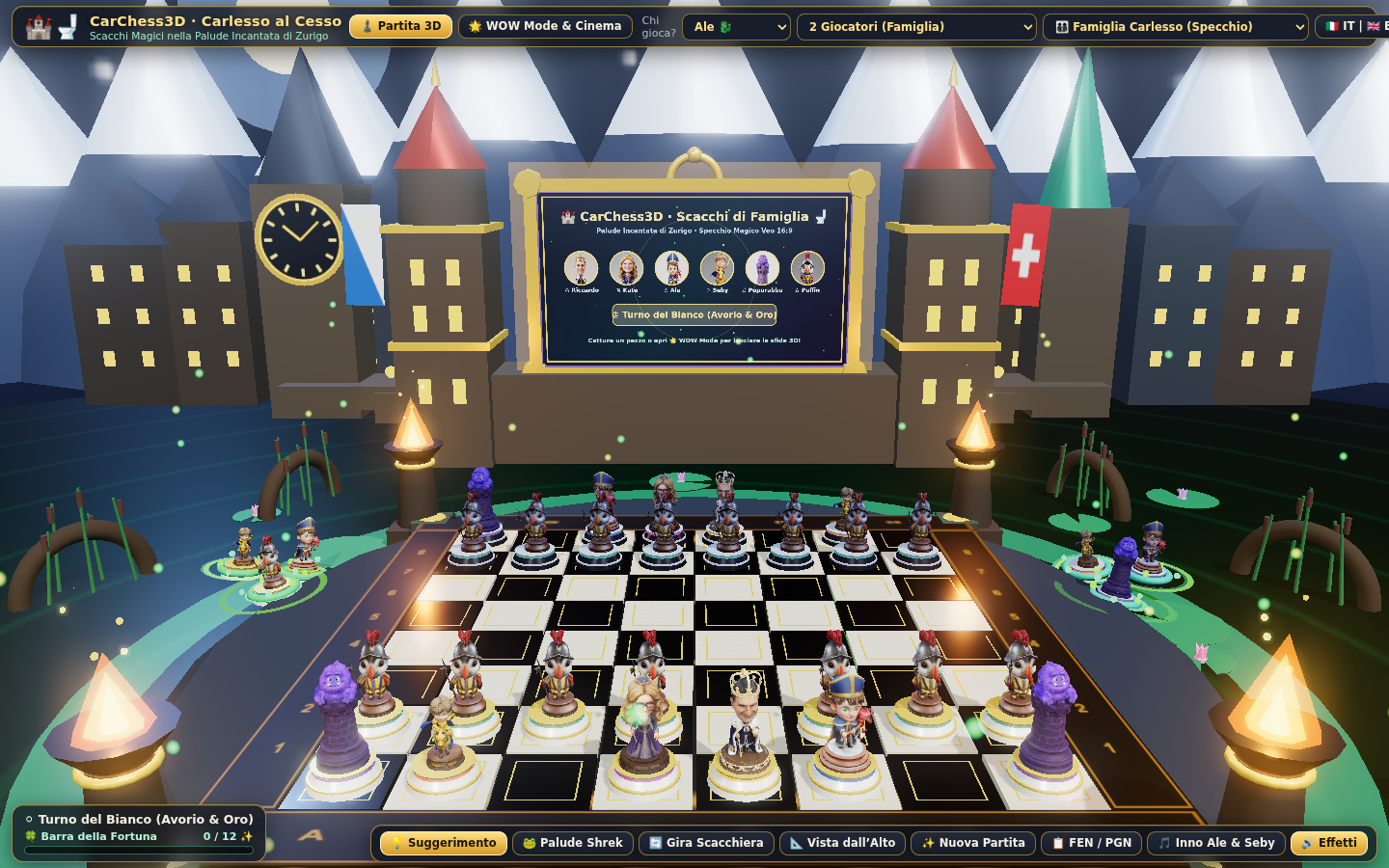
The result of that weekend? A complete, offline-first (PWA), zero-build-step 3D Battle Chess game set in the Enchanted Swamp of Zurich (Swamp-on-the-Limmat): CarChess3D (🏰🚽 “Family Chess”) .
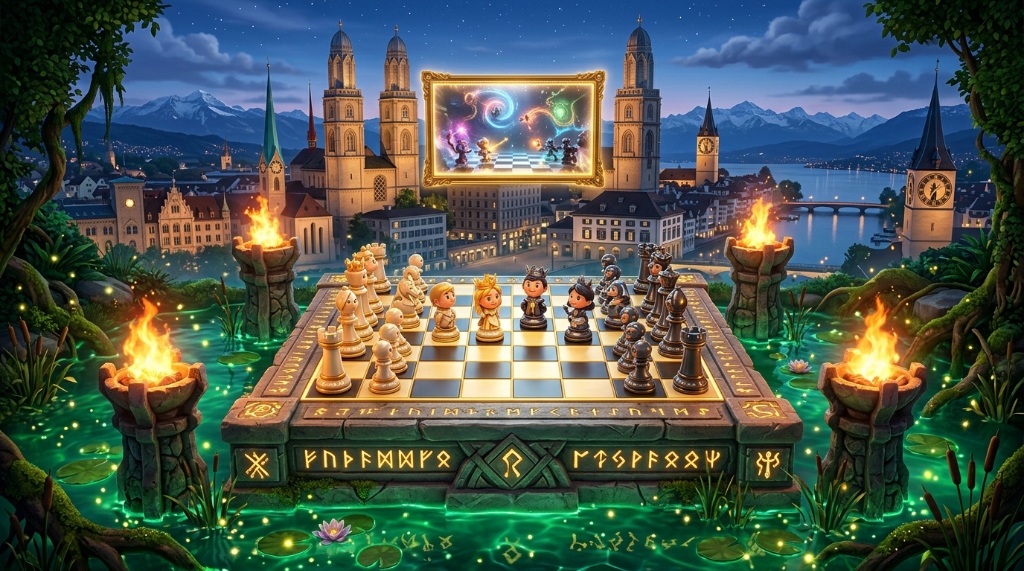
One of the very first images Nano Banana produced on day one, from a single paragraph of prompt. Everything that followed — the swamp, the torches, the lily pads, the floating 16:9 battle screen — was the agents trying to live up to this picture.
⏱️ 2. SRE Telemetry: Proving “Built in a Weekend” Down to the Second
As an old-school Site Reliability Engineer (SRE), marketing fairy tales don’t impress me. I only trust hard numbers, immutable timestamps, and cryptographic git commit hashes.
Here is the exact telemetry extracted from git log and the 76 CarChess3D Antigravity sessions across pupurabbux (article/sources/chats_list.md, 22 3D/GPU sessions) and cpu-box (article/sources/chats_list.md and article/ANTIGRAVITY_FORENSICS.md
, 54 orchestration, Swarm, and VLM Critic sessions):
| |
⚡ 38 Minutes from /goal to a Playable Game (Saturday, October 10)
At 10:31 on Saturday morning, right before heading out into the cobbled streets of Colmar, I fired a single /goal command in an isolated git worktree. My humongous /goal prompt is here — steal it!
(I had Gemini 4 High write it for me, with a good dose of inspiration from 💼 Geneviève Huskens
’ 3D agent workflows — see the two tips below).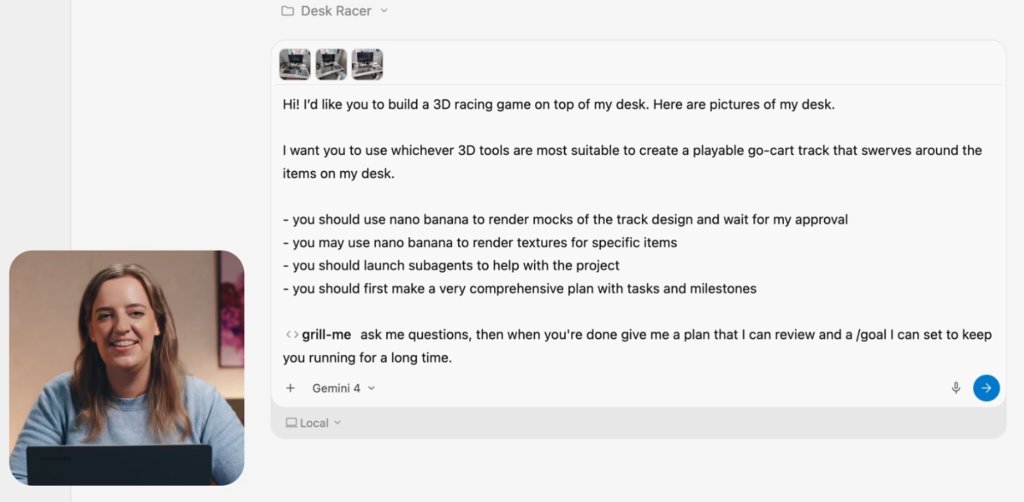
▶️ Watch Geneviève’s 2-minute “Desk Racer” demo on LinkedIn — she builds a 3D go-kart game on top of her own desk with exactly this prompt.
💡 Two tips I stole from Geneviève Huskens :
- Start with
/grill-me: “ask me questions, then when you’re done give me a plan that I can review”. Let the agent interview you until the plan is solid, instead of dumping a vague wish on it.- Ask for the
/goalas a deliverable: "…and a/goalI can set to keep you running for a long time". The agent writes its own long-running meta-prompt — milestones, checkpoints, how to self-verify — and you fire it and walk away. That is exactly how my humongous/goalwas born, and why I could spend the weekend in Colmar.
✍️ Post-review update. When Geneviève reviewed this article she made one sharp observation about that prompt: it micromanages the subagents — I had told the orchestrator exactly which four agents to spawn and which files each one owned. She is right: the human should state outcomes, guardrails and exit gates, and let the planner plan. So here is a clean, reusable
/goaltemplate with the project-specific noise removed and the subagent decomposition handed back to the agent. Steal that one.
Here is the timeline recorded in the transcript:
10:31Phase 1 — 2D blueprint & spatial metric (9m 17s): a metric floor plan of the board (y = 0.00 m) and an automatic bounding-box grounding utility, so every future 3D piece would stand exactly on its square.10:41Phase 2 — headless core, test-first (7m 03s): event bus, seeded random generator, chess-rules manager and the kid-friendly luck meter, each with unit tests (including a 10,000-capture Monte Carlo run).10:50Phases 3 & 4 — four subagents in parallel (19m 35s): +10,081 lines across 60 files in 19 minutes — the 3D Zurich swamp scene, piece rendering, particle effects, the HUD and the offline-first service worker.11:09✅ A playable, unit-tested 3D chess game in the browser — 38 minutes and 6 seconds after/goal.11:13Phase 5 — adversarial critic loop (65m 33s): the critic scores round 1 at6.2/10, catches 5 defects (including a glTFmetallicFactortrap that made everything look like chrome), and iterates until9.9/10at12:18.
💡 SRE Verdict: 38 minutes to a working game, 1 hour 47 minutes to one the critic was happy with — with zero human input in between.
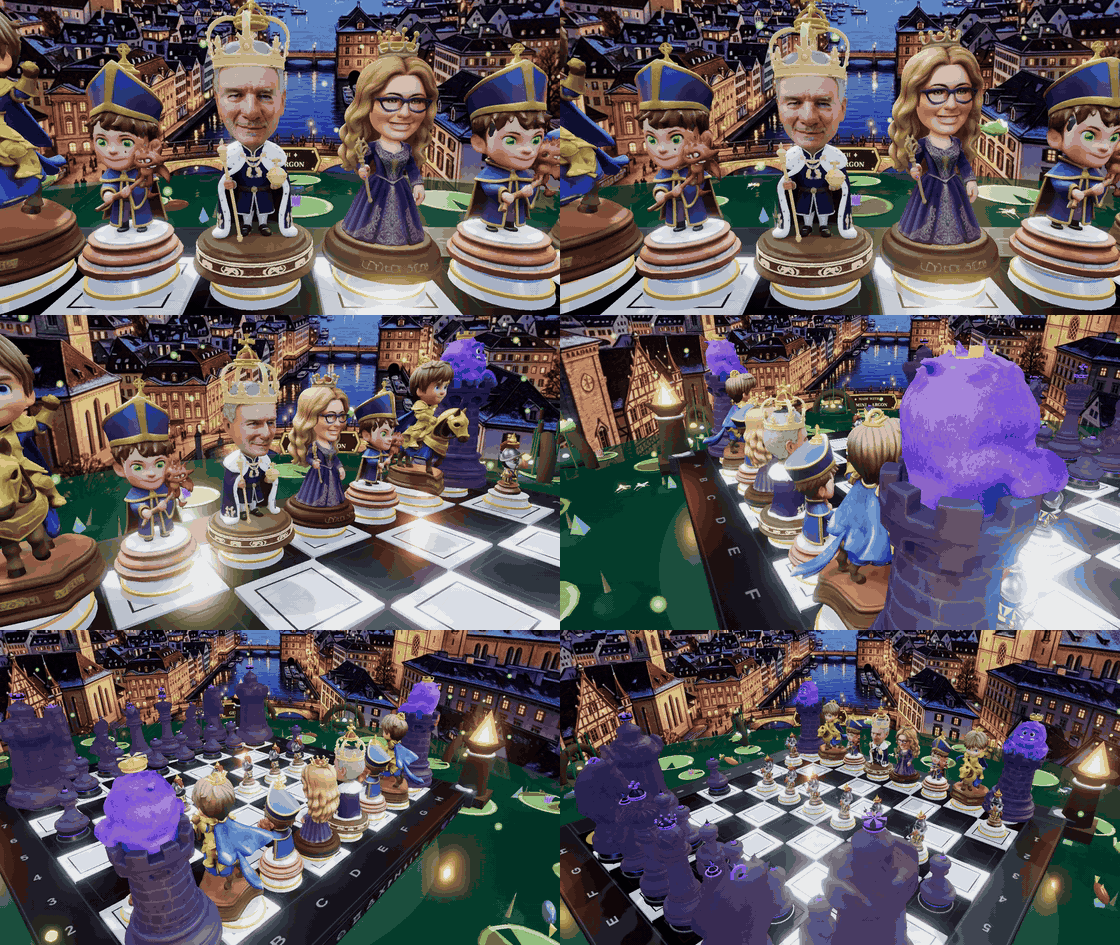
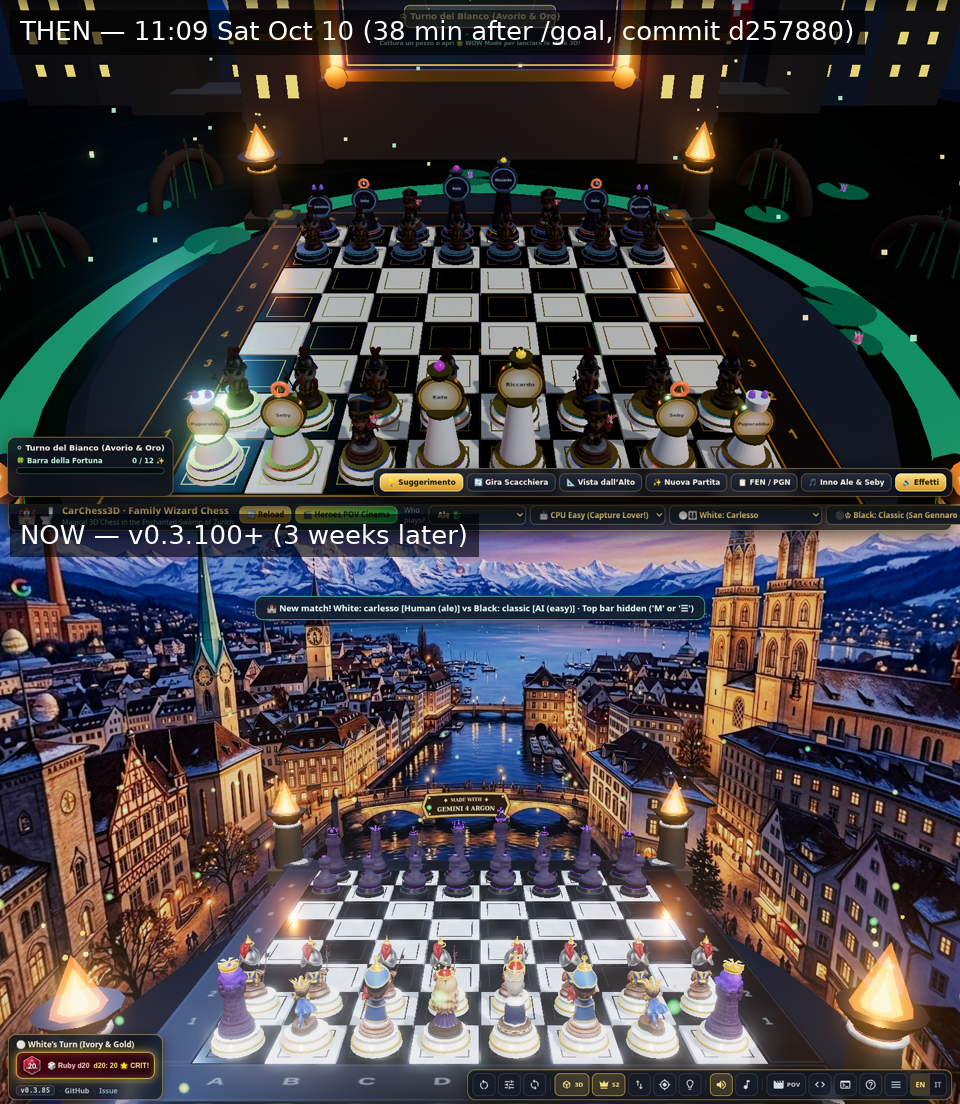
And because git never forgets, here is what that 38-minute game actually looked like (commit d257880, checked out and booted again today) next to the current build — same board, three weeks of autonomous loops apart:
⏳ How Long Can Gemini Actually Run Unattended?
The million-dollar question with AI coding agents is always: “How long can they actually run on their own before hitting a wall or begging a human for help?”
Looking at the raw Antigravity logs across both machines, here are the longest unattended autonomous runs:
| 🖥️ Machine | Session / Mission | Start (UTC) | 📜 Steps · 🔧 Tool Calls · 🐝 Agents | ⏱️ Span | Autonomous Outcome |
|---|---|---|---|---|---|
pupurabbux | Kickoff & 3D Factory (940b9eac) | Oct 09, 15:43 | 2,366 · 1,080 · 107 | 110h | Scaffold, multi-view generation, 26-bone Blender rigging, pipeline orchestration. |
cpu-box | MAIN Merger & Daily UAT Sentinel (83ee7dd5) | Oct 10, 07:37 | 2,399 · 1,120 · — | 5 days | Multi-machine git sync (cpu-box ⇄ pupurabbux), English UI default, automated Playwright video UAT on GitHub Issues. |
cpu-box | Autonomous v1 /goal + 6×6 Swarm (31759f77) | Oct 10, 08:31 | 2,667 · 1,240 · 15 | 4 days | Complete v1 game in 38m, 5-worker 6×6 Swarm, 36 Veo 3.1 videos, family TTS voices & Lyria 3 strings. |
pupurabbux | Issue #20: 12 GLB Reconstruction (18347678) | Oct 13, 18:12 | 686 · 375 · — | 12h 12m non-stop | High-resolution local GPU reconstruction of all 12 Classic and Swamp pieces on the RTX 5080. |
👑👦👶 3. The Family Cuteness Factor: Who Is on the Board?
Instead of anonymous wooden horses and pawns, every piece in CarChess3D is an affectionate, slightly ridiculous caricature of our family:
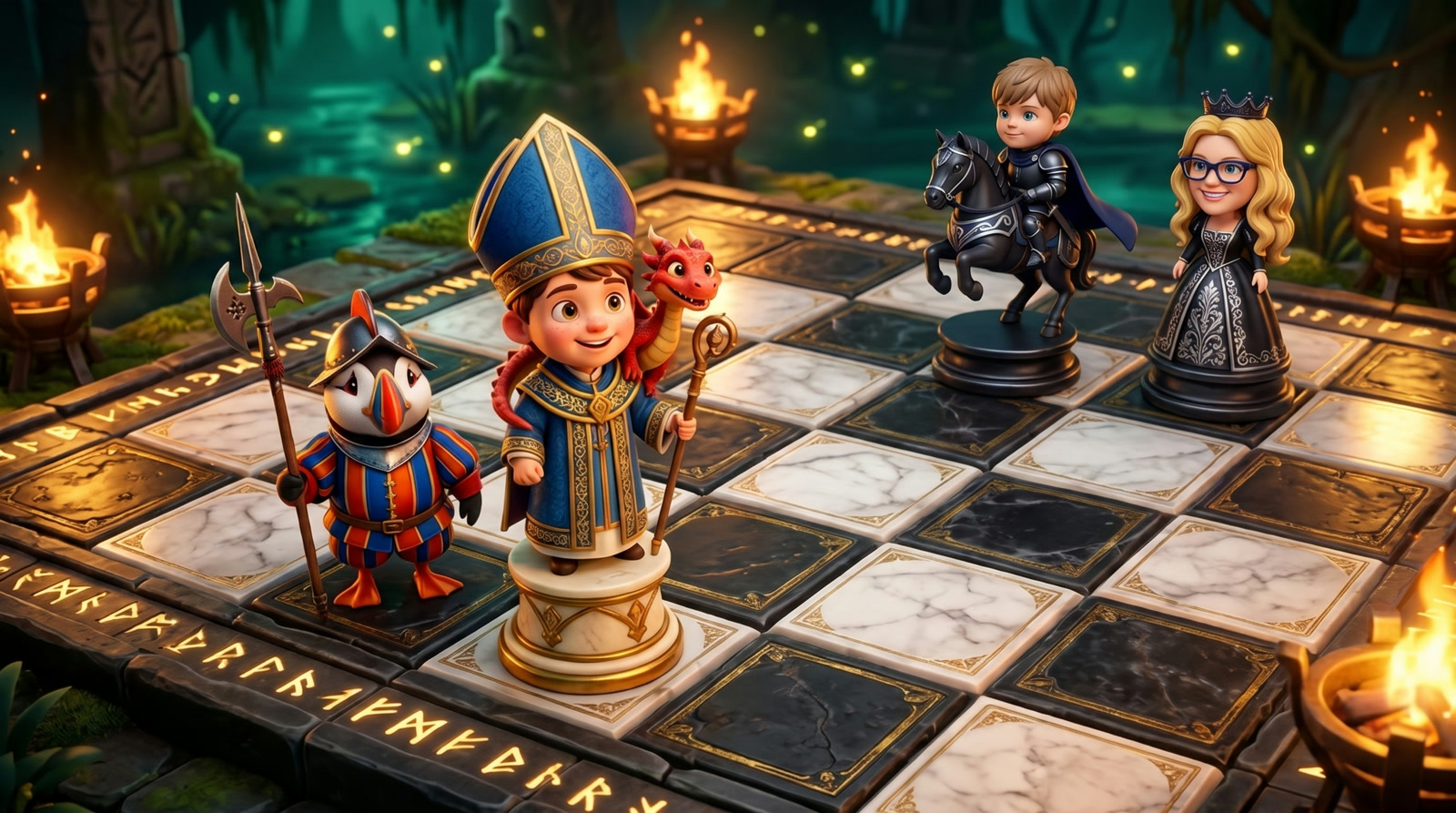
Early concept art, retouched with Nano Banana: the white Puffin and Bishop Ale face a black-team Seby and Kate — a Carlesso vs. Carlesso mirror match.
| Piece | Who | Why |
|---|---|---|
| King 👑 | Riccardo (Dad) | Inspired by a fantasy mage: six spells for six different fights — and yes, a golden throne 🚽. |
| Queen 👸 | Kate (my wife) | She works in chocolate, so every one of her attacks is chocolate-based. 🍫 |
| Bishop 🐉 | Ale (Alessandro) | Ale loves wizard stories and dragons, so the bishop is a young wizard with a tiny dragon familiar. |
| Knight 🏎️ | Seby (Sebastian) | He rides horses, so the choice was obvious. |
| Rook 🏰 | Pupurabbu | Seby’s imaginary purple fluffy friend, peeking out of a stone tower. 💜 |
| Pawn 🐧 | Puffin (×16) | My wife calls me Puffin; the insider joke was irresistible. Swiss Guard uniform included. |
🎠 Meet the Kids in 3D
| Seby — Knight 🏎️ golden armor on his warhorse, 1.92 m | Ale — Bishop 🐉 wizard's mitre with his little dragon, 1.55 m |
The two reconstructed .glb figurines on a 360° turntable (RTX 5080 render, 8 s loop). Full 6-piece lineup below.
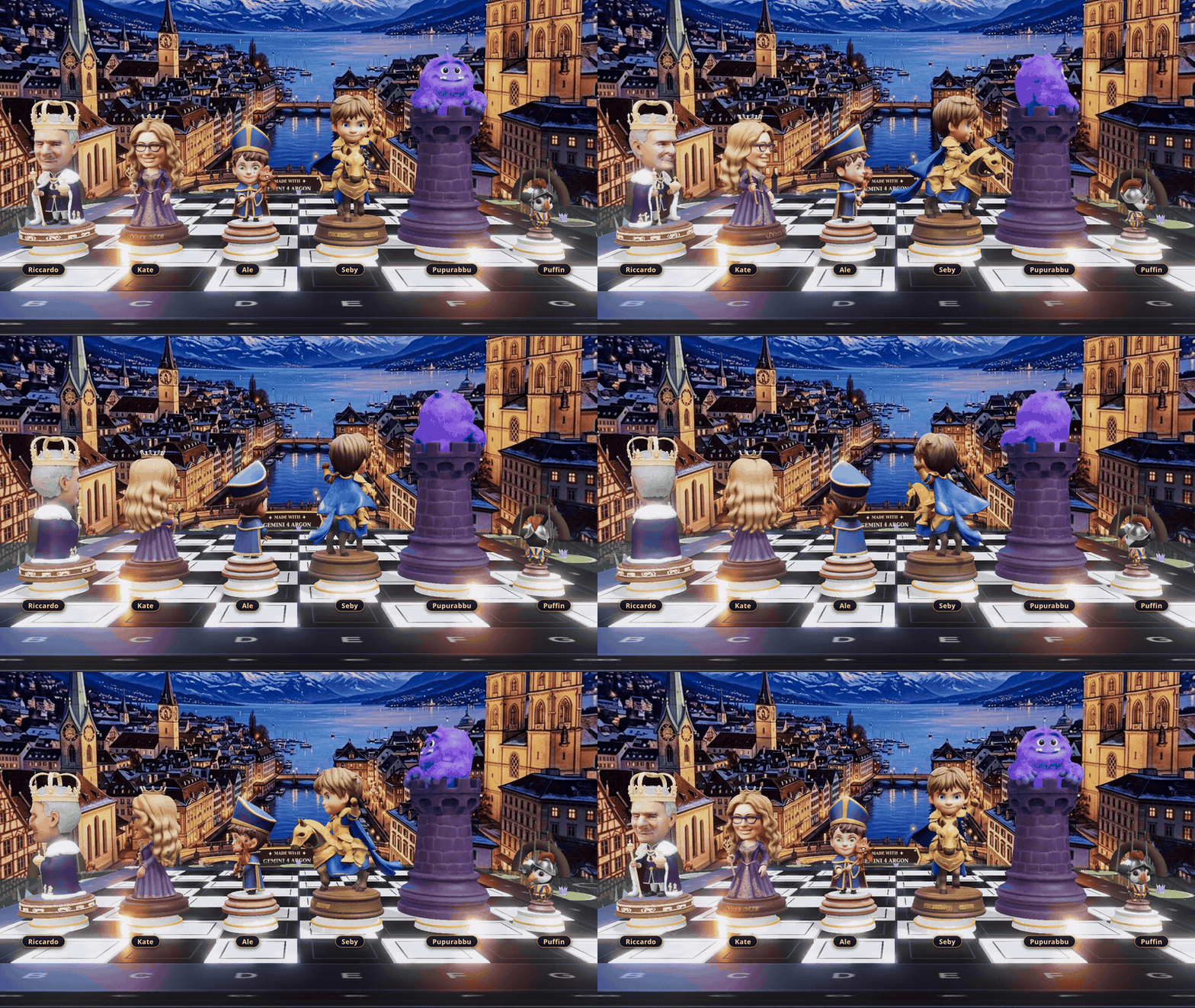
Here they are, all six reconstructed .glb figurines (Riccardo · Kate · Ale · Seby · Pupurabbu · Puffin, each scored 9.7/10 by the critic) rotating 360° side by side at their true relative heights (0.80m → 2.50m; scripts/family_turntable_6up.py
· MP4
):
💜 The Brotherly Easter Egg: The “Mega Fluffy Cuddle”
Inside the combat rules engine (src/managers/CombatAnimationManager.js), one hard-coded law is sacred: Sebastian and his plushie Pupurabbu can never hurt each other.
Whenever Knight Seby captures Rook Pupurabbu (or vice versa), there is no explosion and no knock-out: the two rush together into a SUPER FLUFFY HUG! 💜🤗 while a shower of 3D pink hearts rains down over the board!

Seby and his imaginary friend cannot fight — they can only hug. (Veo 3.1 clip, MP4 .)
🐸 The Ogre’s Swamp Party
Captured pieces don’t vanish into a boring sidebar graveyard. They fly along a parabolic arc, splash into the Enchanted Swamp — a stylized 3D Zurich, with the Grossmünster towers, the Limmat and the lake as backdrop —, and bob happily on floating lily pads amid glowing ripples and swamp fireflies!
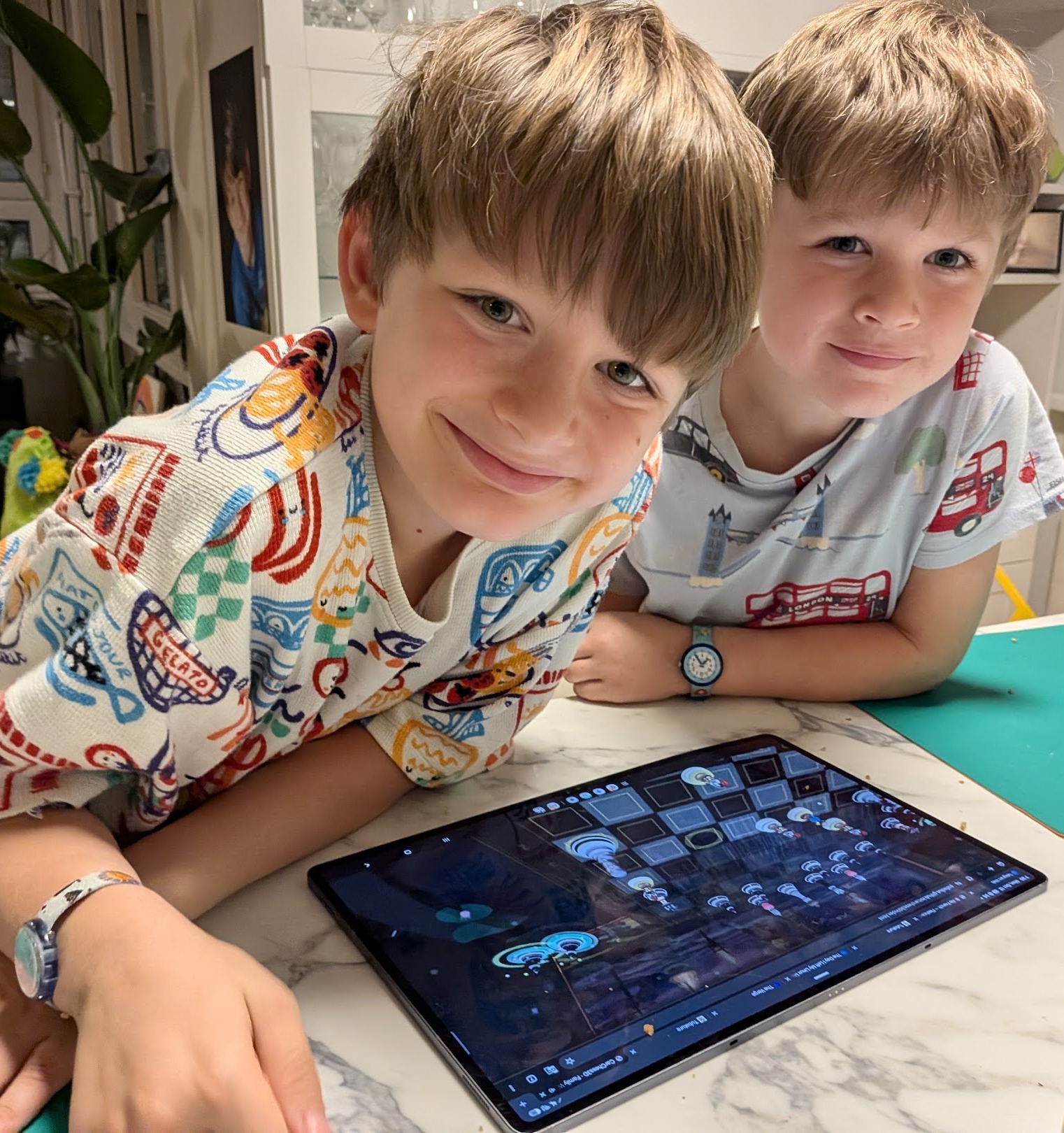
👨👦👦 The Real UAT (User Acceptance Testing): Ale & Seby on the Tablet
No automated test suite can beat the final sign-off from the actual customers: here are Alessandro (🐉) and Sebastian (🏎️) heads-down on the tablet playing CarChess3D, with the 3D pieces on the board and the swamp lily pads glowing in the background!
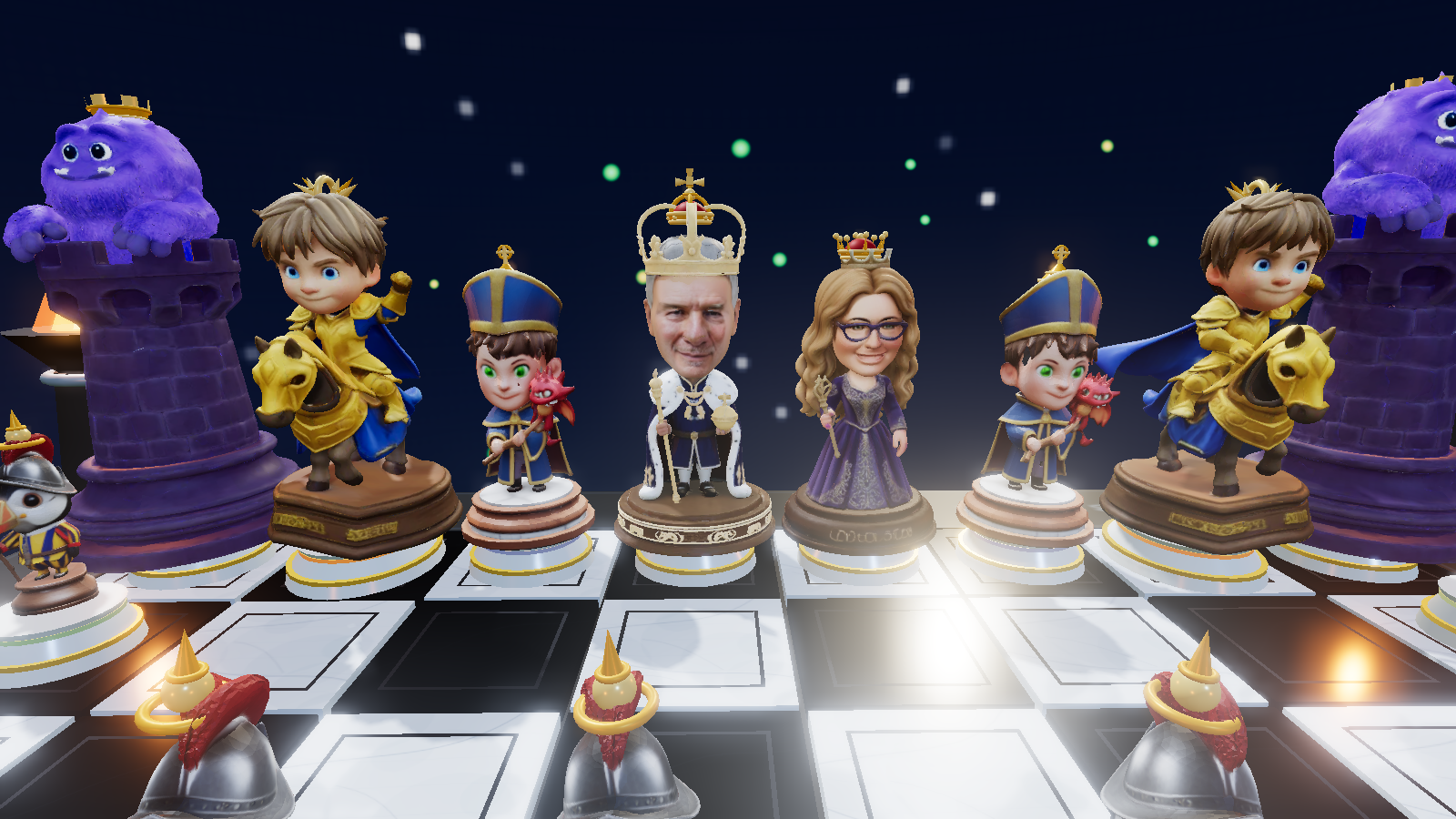
👨👩👦👦 The Family Portrait
Advance pawns b–g two squares, put the camera at board level in front of the white back rank, hide the HUD, and you get the real reason this project exists: Seby, Ale, Dad, Mum, Ale again and Seby again — with Pupurabbu’s purple tower on the flank and the Puffin Swiss Guard helmets peeking in from the front row (scripts/family_portrait_shot.py):
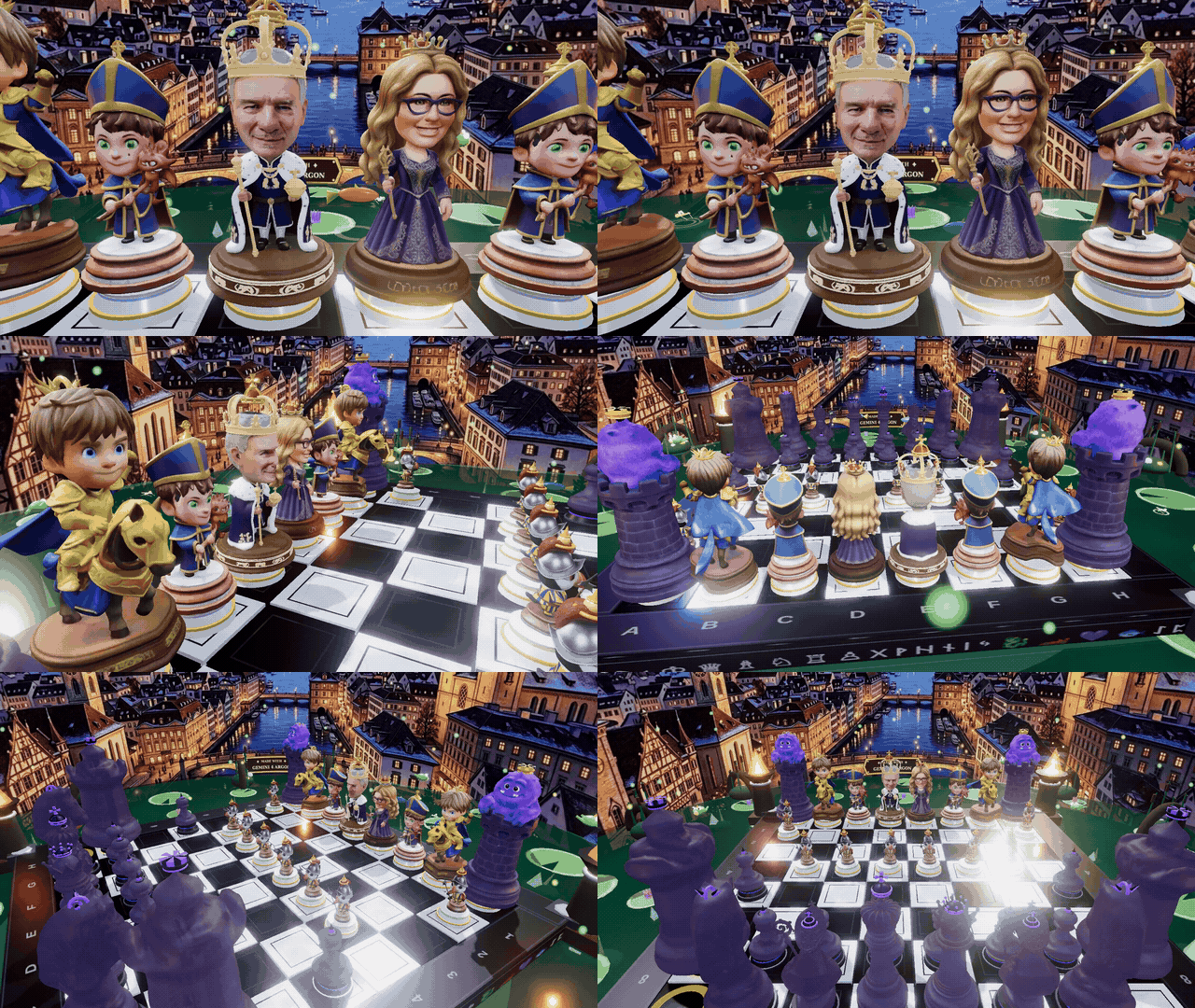
And here is the 12-second cinematic demo sweep (scripts/family_orbit_video.py, rendered on the RTX 5080): starting from a wide aerial establishing view over the Zurich board, swooping down to eye level, holding at the front portrait, and orbiting -150° → +150° around the whole family:
🎠 4. WOW Gallery: The Carlesso Family Figurines
These are the 2D concept turnarounds (front + 3/4 view) generated with Nano Banana 2.1 from real family photos. They are the “ground truth” every 3D engine had to chase:
| Dad (King Riccardo 🚽👑) | Mum (Queen Kate 👸💜) |
|---|---|
 |  |
| Royal crown, ermine-trimmed cloak, scepter and golden “Riccardo” plaque | Purple damask gown, gold ring, and navy glasses |
| Bishop Ale & His Dragon (🐉💎) | Knight Seby on His Steed (🏎️✨) |
|---|---|
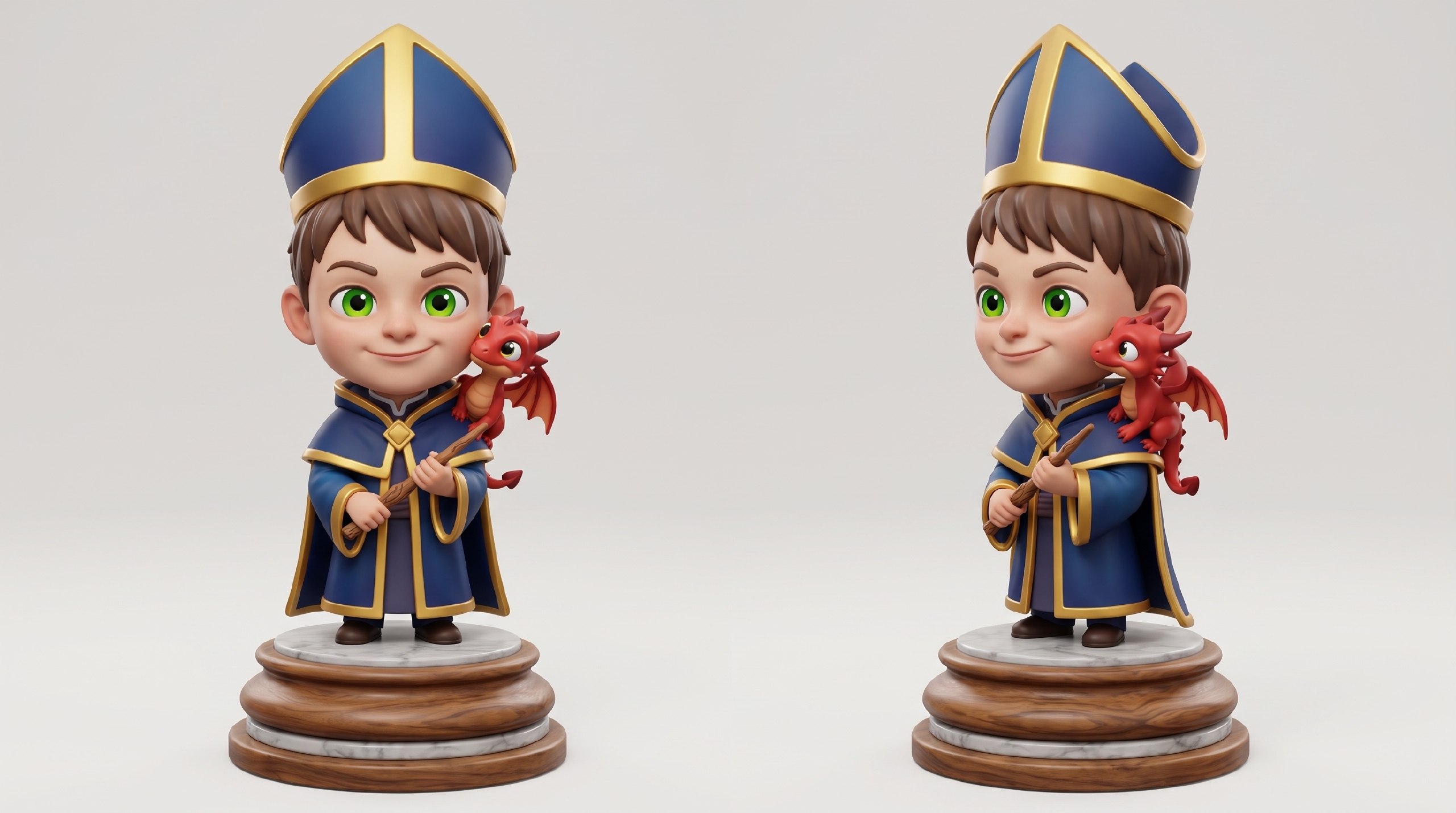 | 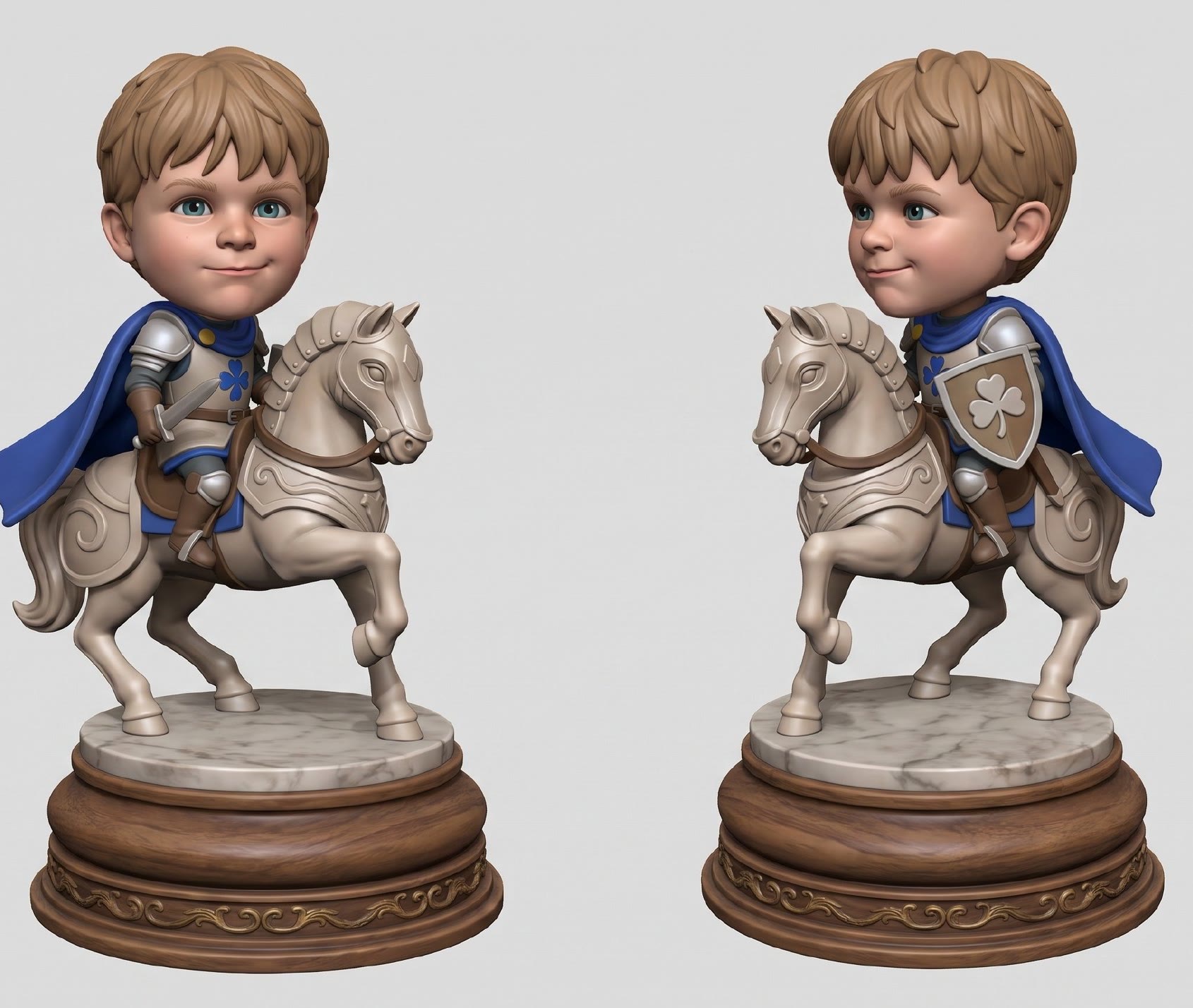 |
| Episcopal mitre, crozier and shoulder dragon | Silver armor, blue cape and wooden lance on his warhorse |
| Pawn Puffin (Swiss Guard 🐧🛡️) | Rook Pupurabbu (Purple Fluffy Tower 🏰💜) |
|---|---|
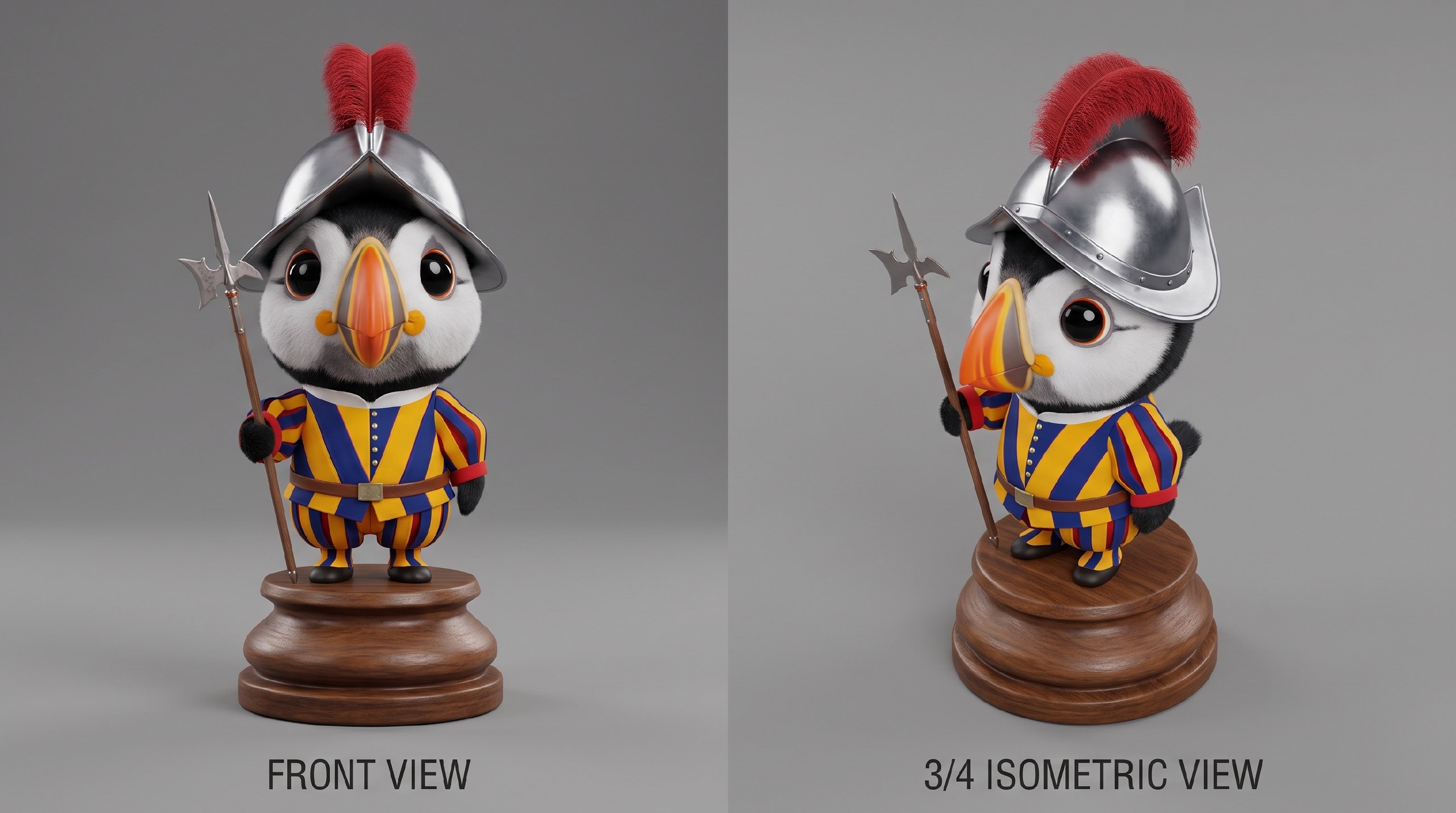 | 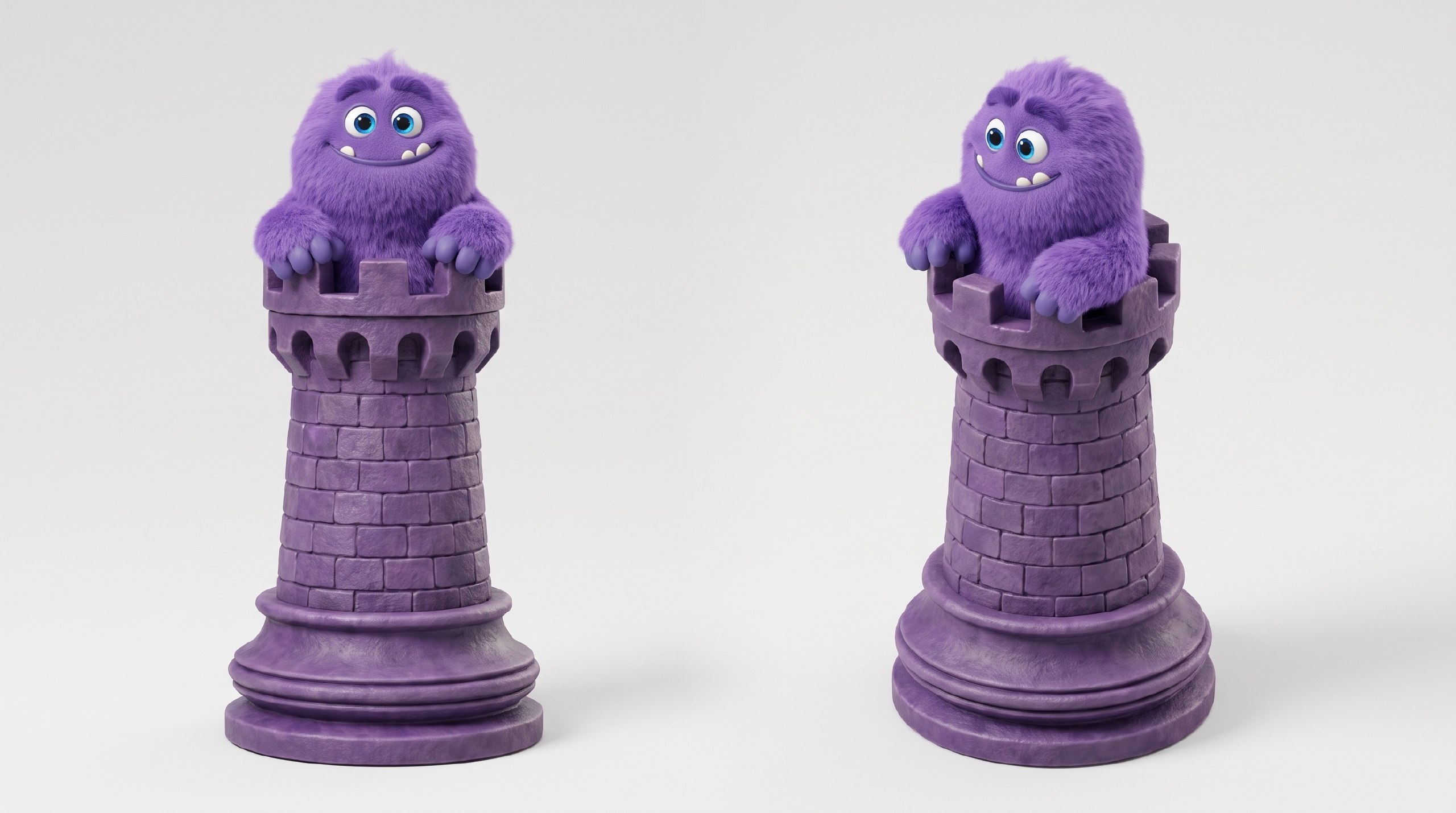 |
| Morion helmet with red plume and halberd | A fluffy purple monster peeking out of a stone keep |
🔬 5. Technical Deep Dive: Sculpting 3D Pieces from Family Photos
Turning a casual smartphone photo into a textured, metrically grounded .glb that runs at 60 FPS on a tablet boils down to four steps — generate, reconstruct, slim down, judge:
flowchart LR
    A["📸 Family photo"] --> B["🍌 Nano Banana<br/>4-view turnaround"]
    B --> C["🧊 3D engine<br/>TRELLIS · Hunyuan3D-2 · SDF"]
    C --> D["📐 Decimate<br/>700k → 60k faces"]
    D --> E{"🤖 Critic<br/>≥ 8/10?"}
    E -->|yes| F["✅ assets/models/*.glb"]
    E -->|no| G["🩹 Face-graft / Blender remaster"] --> C
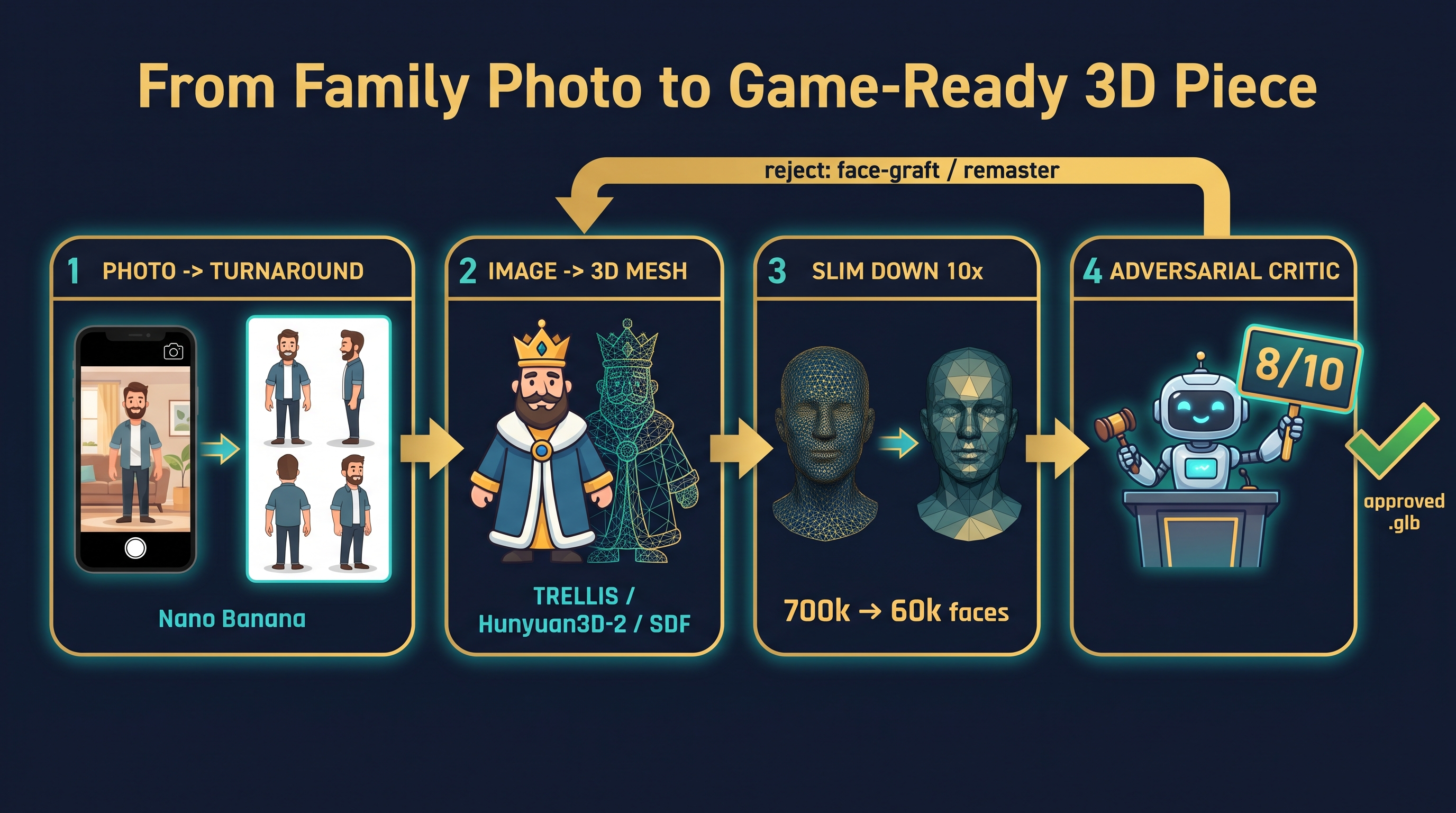
Step 1: From Smartphone Photo to 4-View Orthographic Turnaround with Nano Banana 2.1
3D diffusion models hate wide-angle perspective distortion. Using Nano Banana 2.1 (gemini-nano-banana-2.1) and Nano Banana Pro (gemini-3-pro-image-preview), we generated strict orthographic sheets:
- Front (0°): symmetrical heroic pose.
- Side (90°): pure lateral profile (essential for King Riccardo’s nose/crown profile and the Swamp Donkey’s snout).
- Back (180°): full rear view (preventing 3D models from having flat, hallucinated, or unpainted backs).
- 3/4 Isometric: volumetric depth reference.
Step 2: The Four 3D Reconstruction Engines
Engine 1: Cloud Multi-View Diffusion (TRELLIS) and the Undocumented /lambda_1 Bug
TRELLIS produces great PBR meshes, but we uncovered a nasty bug in its Gradio backend: calling the API via Python silently ignored every image after the first because the internal is_multiimage = gr.State(False) flag was only toggled when a human clicked the “Multiple Images” tab in the browser UI — which fired an undocumented endpoint named /lambda_1.
Once our script (gen_mv.py) explicitly invoked /lambda_1 right after /start_session, TRELLIS finally fused front, side, and back views together!
Engine 2: Local GPU Pivot on pupurabbux (NVIDIA RTX 5080 + TurboSebux)
When Hugging Face ZeroGPU hit quota limits (“Exceeded ZeroGPU quota”), the agent didn’t stall waiting for a credit card. It pivoted autonomously to my home PC’s local hardware:
- External Samsung T7 SSD: mounted a 600 GB ext4 loop volume at
/media/riccardo/TurboSebuxso root/wouldn’t fill up. - Hunyuan3D-2 Shape: generated complete meshes locally in 32 seconds using just 5.6 GB of VRAM on the RTX 5080.
- Blackwell
sm_120CUDA PTX JIT Fix: Because prebuilt PyTorch/rasterizer wheels didn’t yet include native binaries for NVIDIA’s new Blackwellsm_120architecture (cudaErrorNoKernelImageForDevice), the agent recompiledcustom_rasterizer_kernelwithTORCH_CUDA_ARCH_LIST="9.0+PTX", leveraging the NVIDIA driver’s PTX JIT compiler.
Engine 3: Slimming Down 10× with Quadric Edge Collapse 📐
A raw mesh out of Hunyuan3D-2 has ~700,000 triangles (12.5 MB) per piece: with 32 pieces on the board that is 22 million polygons, and any tablet browser gives up. Quadric Edge Collapse (Garland & Heckbert, 1997) merges the edges that matter least first, so we went from 697k to 60k faces (12.5 MB → 1.0 MB) in under 10 seconds while keeping faces, crowns and noses intact.
Engine 4: Mode B Biometric Face-Grafting ($2048 \times 1024$ Dual-Chart WebP Atlas)
My initial King mesh looked like a generic, clean-shaven doll. When I complained (“Better, but it still doesn’t look like me! Build an adversarial likeness critic using my 5 reference photos!”), the agent built a Biometric Likeness Critic (riccardo-likeness-critic) scoring 8 facial landmarks (hooded smiling brown eyes, vertical glabellar crease, white tuft on the left eyebrow, rounded nose tip, wide grin, 2-day salt-and-pepper stubble, silver temples, no glasses) and implemented Mode B Planar Face-Grafting:
- Expanded the UV atlas to $2048 \times 1024$: the left half ($u \in [0, 0.5]$) keeps the original 3D robe/crown texture, while the right half ($u \in [0.5, 1.0]$) projects my real South Africa photo onto the 1,483 facial triangles with multi-band Laplacian skin harmonization ($\sigma = 26.0$).
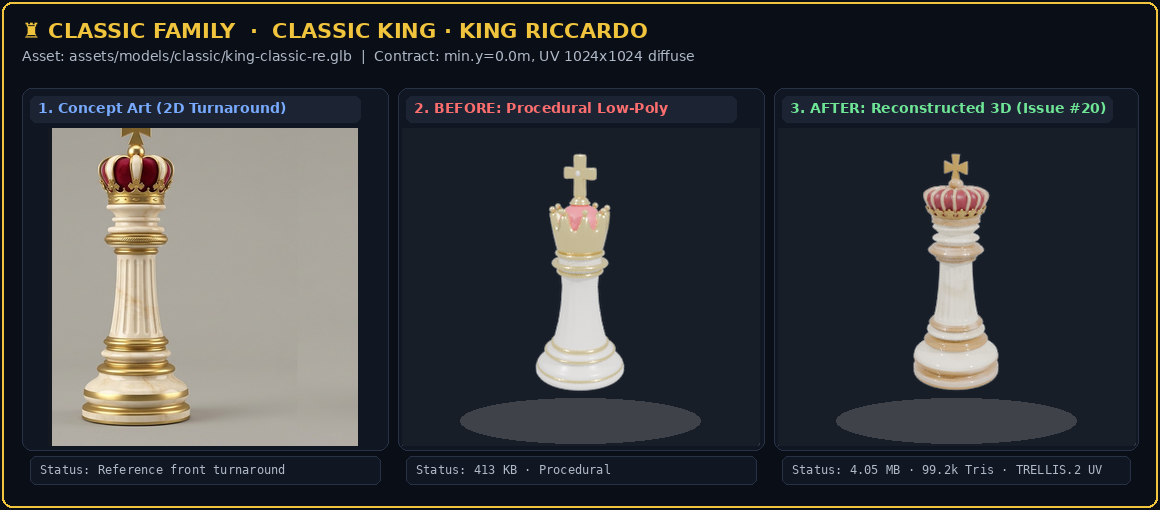
📸 Three-Stage Visual Evolution: The Classic King (Issue #20)
Here is the actual inspection card comparing the 2D turnaround, the legacy procedural placeholder, and the reconstructed 3D mesh:
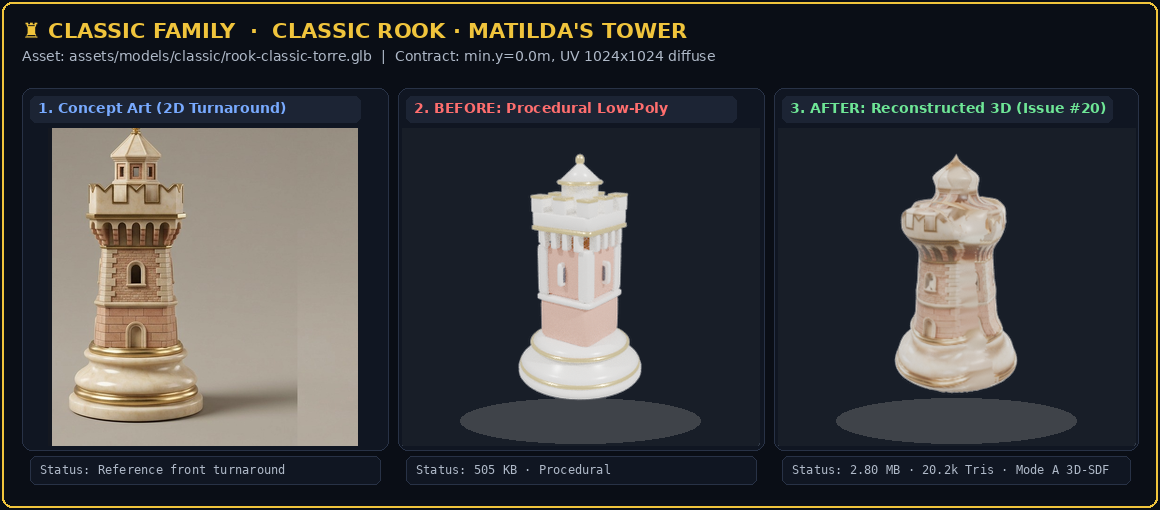
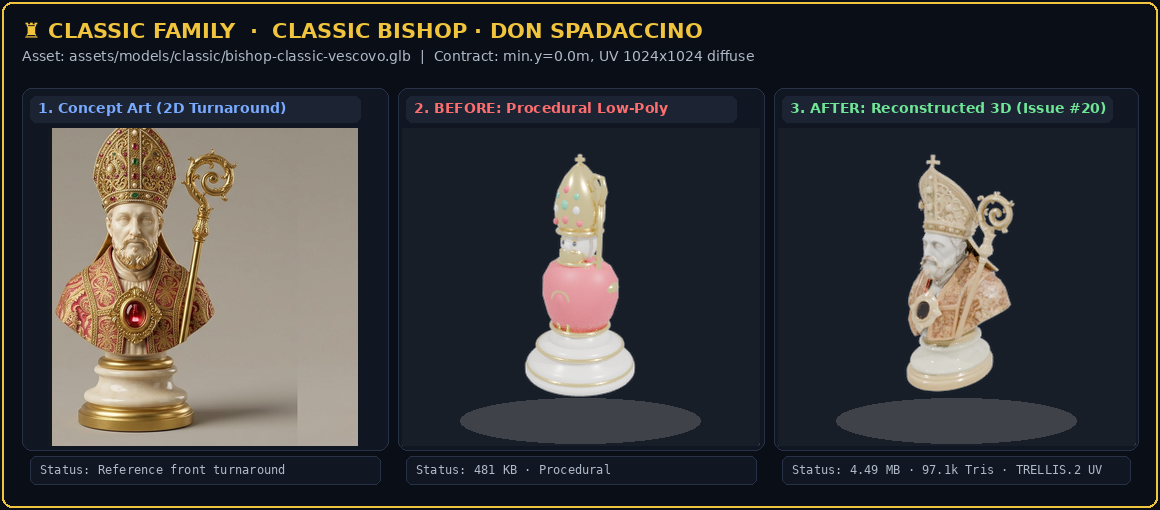
And here are my two favourite reconstructions, the Classic Rook (Matilda’s Tower, Mode A Dual-Orthographic SDF) and the Classic Bishop (Don Spadaccino, TRELLIS.2 multi-view), each shown as Concept Art → Procedural placeholder → Reconstructed 3D (full Before/After lineups of both factions in article/SHOWCASE_BEFORE_AFTER.md
):
🤖💩 6. The Adversarial Critic Loop: Separation of Powers
Left to themselves, generative pipelines happily ship deformed meshes or broken shaders. To prevent this, we enforced a strict separation of powers:
- Builder Agents (write code, sculpt 3D models, render videos).
- Adversarial Critic Agents (isolated read-only verifiers armed with Gemini VLM, Claude Fable 5.1 High, and Blender Cycles/EEVEE).
After every 3D build, a headless script shoots a 4-camera contact sheet (3/4 Overview, Close-Up, Ground Test y=0.00m, and Wireframe) and updates docs/qa-scores.yaml:
TOP_QUALITY 🟢($\ge 8.0/10$)ACCEPTABLE 🟡($6.0 - 7.9/10$)FA_CAGARE 💩($< 6.0/10$ — literally “it sucks” in Italian)
If a model gets stamped FA_CAGARE 💩, just shittest fails the build and forces a modular rebuild — which is how Bishop Ale v2 (rejected at 4.0/10 because multi-view fusion produced “two half-dragons fused into his chest”) was rebuilt into a clean 26-bone modular rig!
🐝🎬👁️ 7. Inside the 8 Autonomous Antigravity Loops, Multi-Agent Swarms & Daily UAT
Beyond the 3D asset factory on pupurabbux, Antigravity on the cpu-box ran 8 major autonomous loops (full forensic dossier in article/ANTIGRAVITY_FORENSICS.md
):
flowchart TD
    U["🦖 RiccardinoCM26 on cpu-box"] --> L1["🚀 Loop 1: /goal Full Autonomous Build v1 (31759f77)\n4 Parallel 3D Subagents + 4-Round VLM Critic (6.2 -> 9.9/10)"]
    U --> L2["🐝 Loop 2: 5-Worker Native Swarm 6x6 (Issues #10-#16)\n4 File-Isolated Builders + 1 Read-Only Adversarial Swarm Critic"]
    U --> L3["🎬 Loop 3: 36-Battle Nano Banana + Veo 3.1 + Video Critic\nSubagent 6b6faa1f (Gen) + Subagent 4930d699 (Audit >= 8/10)"]
    U --> L4["🗿 Loop 4: Multi-Model Swarm (Fable 5.1 + Argon) + Mode A/B 3D\nClassic & Swamp + Biometric Likeness Critic (8 facial traits)"]
    U --> L5["⏱️ Loop 5: Standing MAIN Merger & Cron Sentinel (83ee7dd5)\n5m/60m Sync cpu-box ⇄ pupurabbux + Daily Playwright UAT Video"]
    U --> L6["🍿 Loop 6: Cinema XXL 16:9 + 10s Pacing (1s+8s+1s) + Audio +15%\nPlaywright Multi-Angle Camera Sim + Zero-Loop Sequencer"]
    U --> L7["📱 Loop 7: Pixel 10 & Tab S9 Ultra WebGL + SW Self-Healing\nDe-Poisoning nocache.html + Lazy GLB Cache + Portrait Scale"]
    U --> L8["👁️ Loop 8: 5-Agent Piece Clarity & Blind VLM Recognizer Swarm\nS1..S5 Visual Aids + Blind VLM Role/Color Accuracy Benchmark"]
1. 🐝 The 5-Worker Native Swarm “Zero-Corner-Cutting” (Issues #10–#16)
When I told the agent “Do NOT cut corners — open an issue for every gap and run an adversarial swarm, even if it takes two days!”, the orchestrator spawned 5 concurrent Swarm workers on a shared message board with strict per-file ownership so merge conflicts were mathematically impossible:
@matrix36-choreo: sole owner ofBattleMatrix36.jsand all 72 video files (36 .mp4+36 .webm).@brawl3d-vfx: owner ofCombatAnimationManager.js— 3-Act 3D comic brawl (CHARGE!→COUNTERATTACK!→K.O.!into the swamp lily pads).@skeletons-locomotion: owner ofSkeletonRigHelper.js— 23 articulated 3D joints, 8-step walk cycle (2.0s), and knight gallop (2.2s).@explorer6x6-ux: owner ofbattles.htmlandHudListener.js.@adversarial-critic: Read-Only Verifier runningscripts/adversarial_swarm_audit.pyto audit the other 4 workers before granting the green light.
2. 🎬 The 36 Nano Banana 2.1 + Veo 3.1 Battle Videos & Kate’s Adversarial Video Critic (>= 8.0/10)
Whenever a piece is captured, the surrounding 3D world dims, the chessboard fades to 90% transparency (alpha = 0.10), the HUD disappears, and a giant 16:9 Cinema XXL screen (videoBoost = 1.75) rises behind the two fighters with a 10.0s timeline (1s pre-roll + 8s Veo video + 1s post-roll) and +15% zero-loop combat music.
When I showed the first batch of 36 Veo videos to my wife Kate, she immediately spotted hallucinations: towers vanishing mid-clip or a second Puffin materializing out of thin air. So we spawned an Adversarial Video Critic subagent (4930d699) that extracted a 6-frame contact strip (t = 0.0s..7.5s) for all 36 .mp4 videos, checked for 4 forbidden defects, logged every score in docs/battles/video_audit.yaml, and regenerated every rejected clip until all 36 scored >= 8.0/10!
3. 👁️ The 5-Agent Visual Clarity Swarm (S1..S5) & Blind VLM Recognizer (Issue #32)
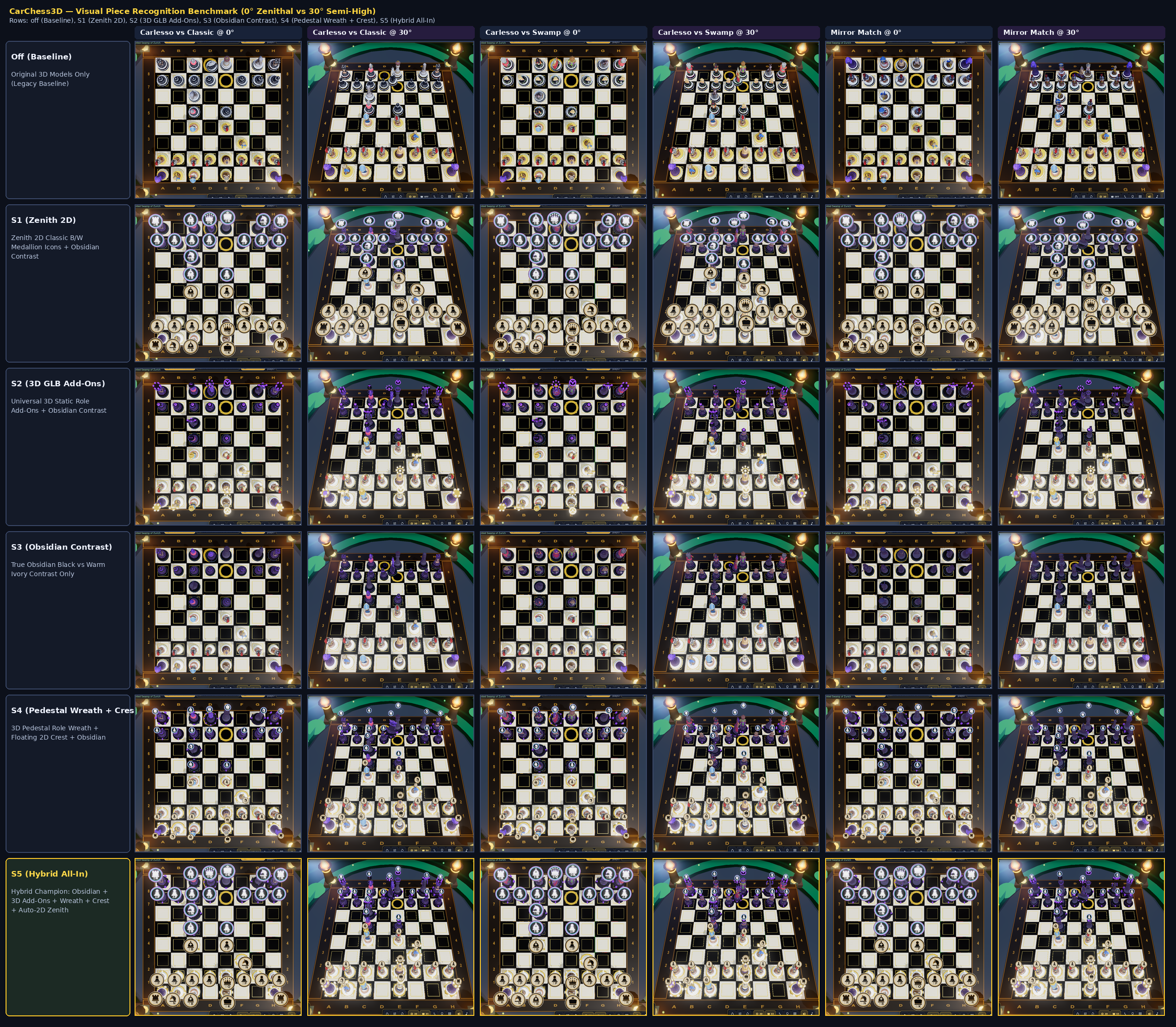
Playing with the kids on the tablet revealed a real UX issue: from overhead (0° zenithal and 30° semi-high), the figurines were so richly detailed that telling White from Black — especially in a Carlesso vs. Carlesso mirror match — caused visual fatigue.
To make sure the board is actually readable — not just pretty — I had the agents build a self-testing benchmark: a blind Gemini model is shown 36 renders and asked to name each piece’s role and color, with no hints. A 5-agent Swarm then designed 5 combinable clarity modes (S1..S5) — matte obsidian vs. warm ivory pedestals, 3D role crowns baked into the .glb files, pedestal wreaths and top-down 2D medallions — and re-ran the benchmark after each one. Recognition climbed from 5.0/10 (off) to 9.5/10 (S5) (full report in article/SHOWCASE_VISUAL_CLARITY.md
):
4. 🧪🤖 Autonomous “Daily UAT Review” with Antigravity on GitHub Issues ( label:"gemini-uat"
)
One of my absolute favorite engineering workflows in this project is the fully autonomous Daily UAT Review powered by Antigravity:
- Every day, a standing scheduled task in Antigravity runs
just daily-uat(scripts/daily_uat_playtest.py+etc/prompts/daily_uat_prompt.md). - The agent launches headless Chromium via Playwright, verifies 9 functional and visual gates (
engine_boot,piece_orientations,camera_flip_180,camera_top_down,skeletons_toggle,swamp_party,matrix36_modal,wow_mode,match_gameplay), plays an actual chess match against CPU Easy through a capture cutscene, performs monkey-testing (like rapidly clicking the🐸 Swampbutton 10 times in a row to verify that exactly 6 pieces swim on lily pads without duplicating or crashing WebGL), and records a complete< 60sgameplay film (MP4 + GIF). - Finally, it uploads the video assets to a dedicated release tag (
uat-media-YYYYMMDD) and automatically opens or updates a GitHub Issue taggedgemini-uat! - You can browse all live daily reports, telemetry tables, and AI-recorded gameplay films directly on GitHub:
👉 GitHub Issues:state:open label:"gemini-uat"(see Issue #18 —Gemini UAT 20261011and Issue #36 —Gemini UAT 20261015).

💛 8. Niccolò’s Game Architecture (niccolo-game-design)
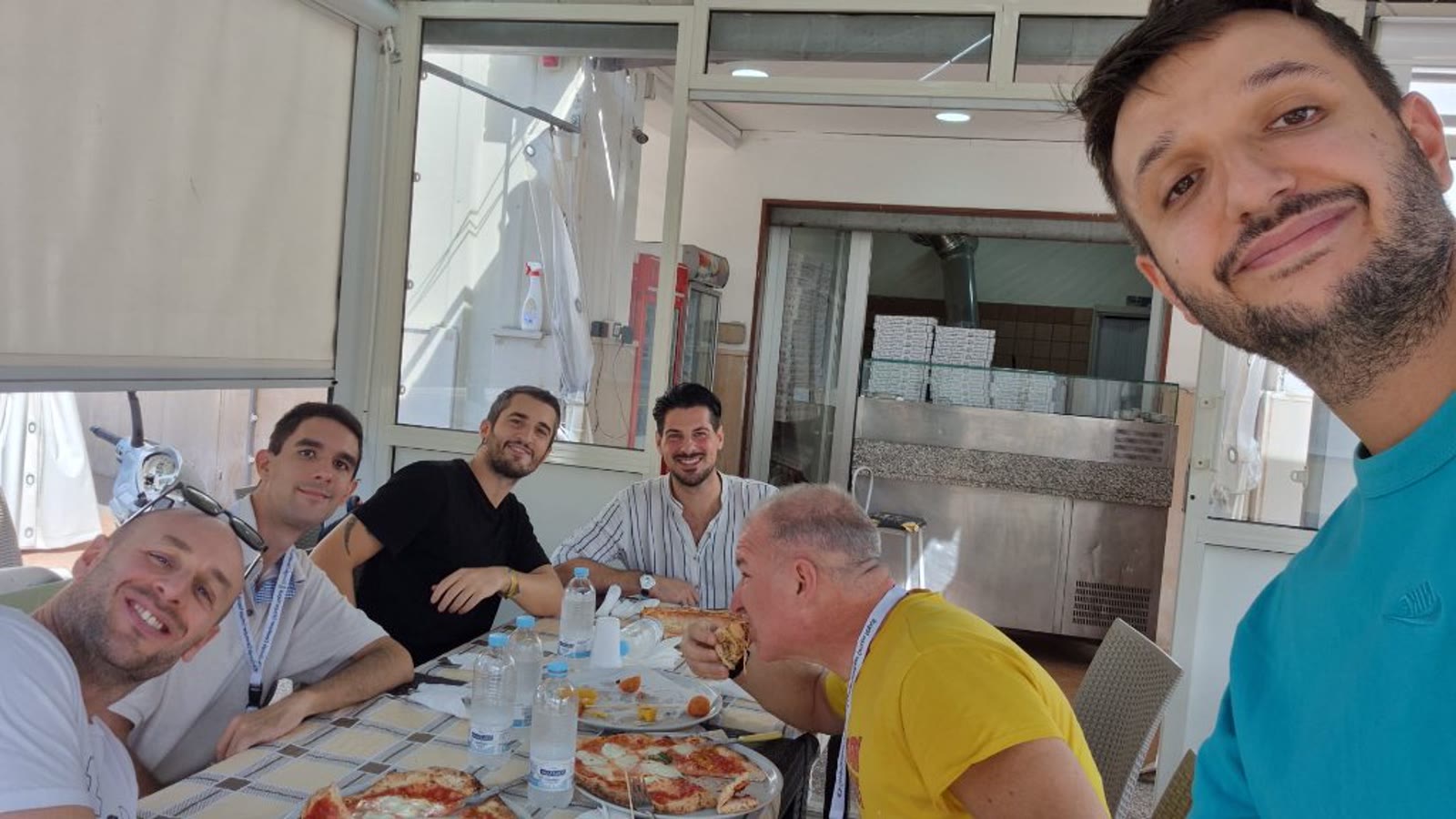
The pizzeria table where it all started — Niccolò is the one holding the phone; I am the one holding the pizza.
To avoid the dreaded “AI Spaghetti Monster” (a monolithic 5,000-line game.js tangled in if/else chains), CarChess3D strictly enforces the rules of the Niccolò Game Design skill
— Managers + Event Bus, a well-known approach Niccolò pointed me to and that is beautifully laid out in Robert Nystrom’s Game Programming Patterns
:
- One Manager = One Responsibility ($\le 300$ LOC per file):
BoardMapManager.js: owns all chess rules (check, checkmate, stalemate, castling, en passant, promotion).DropManager.js: owns the kid-friendly 🍀 Luck Meter (Pity Timer) — every capture adds luck points by piece value (Pawn=1, Knight/Bishop=3, Rook=5, Queen=9), guaranteeing a 100% Golden Crit sticker drop at 12 points!CombatAnimationManager.js: looks upBATTLE_MATRIX[attacker][defender]declaratively with zeroif/elseladders.
- 100% Headless Core:
src/core/,src/managers/, andsrc/ai/contain zero references todocument,window, orTHREE. They run in pure Node.js in under 1.5 seconds with full test coverage. - Deterministic Queued
GameEventBus:
Events describe past facts (PIECE_CAPTURED,LUCK_CHANGED), are queued byemit(), and are flushed once per fixed tick ($1/30\text{s}$) byflush(), eliminating re-entrancy bugs and race conditions. - Listeners, Never Callers:
3D views, WebAudio, HUD, and localStorage subscribe to events. Game logic managers never callsound.play()or mutate DOM nodes directly.
🎮 9. Try It Yourself in 10 Seconds
Zero heavy installs, zero bundlers, zero Webpack or Vite:
| |
Or play directly online on GitHub Pages:
- 🏰 CarChess3D Full Game:
https://palladius.github.io/carchess3d/ - 🐸 Swamp Party with Captured Pieces:
https://palladius.github.io/carchess3d/?swamp_party=1 - 🟢 Legal Move Dots & Capture Reticles:
https://palladius.github.io/carchess3d/?demo_moves=1 - 🎬 Heroes POV Cinema & Family Soundboard:
https://palladius.github.io/carchess3d/showcase/?view=pov - 📸 Visual Progress Gallery (Round 1 → Round 4):
https://palladius.github.io/carchess3d/progress.html
🥂 10. Conclusion: Engineering in the Age of Autonomous Swarms
Two years ago, building a custom 3D video game starring your own family — complete with watertight textured meshes, skeletal rigging, event-driven architecture, a Web Worker chess AI, 36 AI battle cutscenes, baroque string music, and bilingual voice acting — would have taken an indie studio four months and tens of thousands of euros.
Today, combining frontier models like Gemini 4 , Antigravity ’s multi-agent orchestration, solid SRE guardrails, and ruthless adversarial critics, the entire universe came together over a single anniversary weekend while the human was clinking Riesling glasses in Colmar.
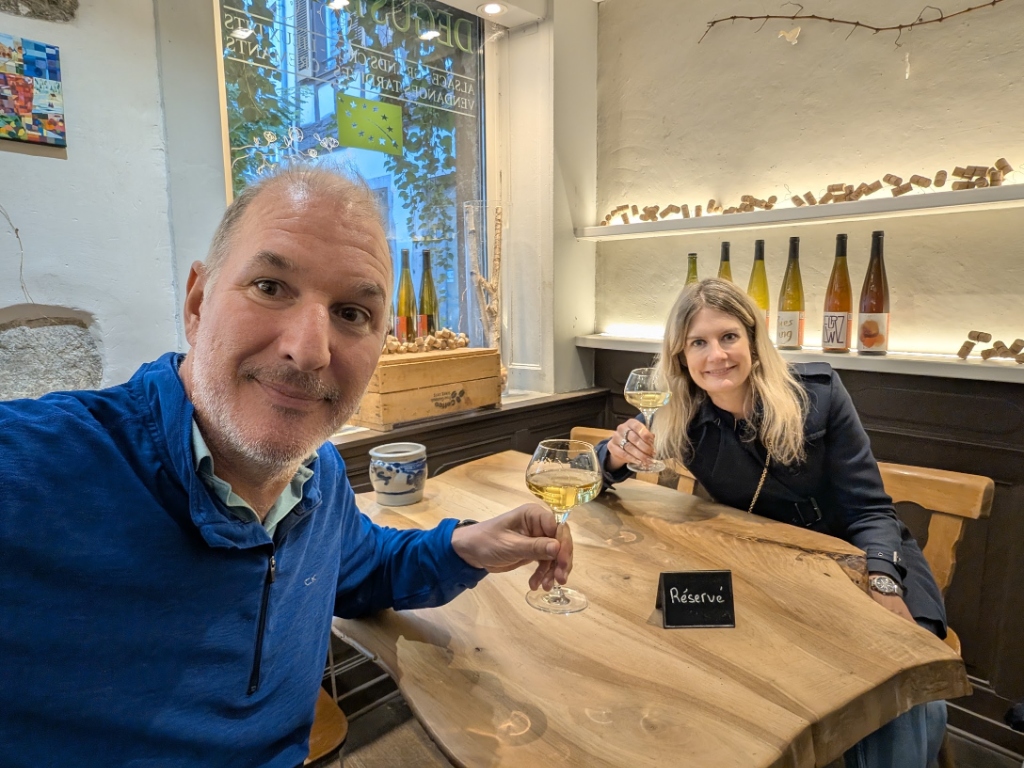
The best technology isn’t the one that chains you to a screen — it’s the one that works quietly in the background, leaving you free to live your life with the people you love.
Have a great match, from the Carlesso Family! 🦖👑👸🐉🏎️💜🐧